

AI Bots Are Already Visiting Your Website. Most Brands Still Aren’t Tracking Them
I opened my server logs expecting the usual mix of some human traffic, some search crawlers in the background. But what stood out immediately was how much of it wasn’t human. Close to half of the visits were bots, and a big portion of those looked like AI agents not just the typical crawlers, but newer ones hitting different pages and moving in ways that didn’t feel random.

At first, it felt like a good sign. If AI systems are visiting your site, it likely means your content is being picked up somewhere. But the more I looked, the less clear it became. Some bots went deeper into content, others just touched key pages and left, and there was no pattern I could confidently explain.
That’s when the real question kicked in:
- What are they actually doing here?
- Are they accessing content in real time because a user asked something, or just collecting it quietly for training without ever sending traffic back?
From the logs alone, I couldn’t tell and that’s where things start to break. Our usual web analytics i.e., Google Analytics (GA4) or Adobe Analytics still show sessions, engagement, and conversions, but almost nothing about how these AI agents move, what they read, or whether they create any real value.
So you end up in a strange spot where traffic is growing, activity is happening, but a big part of it sits in a blind spot. You know something is changing, you just don’t fully understand it yet.
What is AI bot analytics?

And that’s exactly where AI bot analytics starts to come in. At its core, it’s about understanding how non-human visitors, especially AI-related ones interact with your website. Not just spotting that a bot showed up, but figuring out what kind it is, what it’s doing, and whether it actually matters.
Because not all bots are the same. You’ve got the usual ones like uptime monitors or basic scripts, and then search crawlers like Googlebot that index your pages. Most of us are familiar with those. But now there’s a newer layer of AI crawlers and AI agents.
These don’t just index content, they try to understand it, extract it, and in some cases act on behalf of a user, like when someone asks an AI tool to research or compare something. The tricky part is that, in your logs, all of this looks almost identical just a stream of requests hitting your server.
But behind each request is a completely different intent: indexing, learning, or responding to a real-time query. That’s why grouping everything as “bot traffic” doesn’t really work anymore. Bots used to be background noise, but now some of them directly influence how your brand shows up in AI-driven experiences. And if you can’t tell them apart, you’re basically flying blind.
What brands are missing right now
The bigger issue is that most brands aren’t even set up to see this properly yet. We’re still tracking the same things we’ve always tracked: sessions, bounce rate, conversions, maybe some engagement metrics if we’re a bit more advanced. And that’s fine when your audience is mostly human. But it starts to fall short when a growing part of your “traffic” isn’t human at all.
What’s missing is everything happening on the AI side.
How often are these AI crawlers visiting?
Which pages are they actually hitting?
Are they going deep into your content or just skimming the surface?
Are certain sections of your site completely ignored? And more importantly,
Is any of this activity ever translating into real visibility or referral traffic later on?
Right now, most teams don’t have answers to these questions. Not because they’re not looking but because the tools weren’t built for this. So all of this AI activity ends up sitting in a blind spot. You know it’s there, you can see hints of it in logs, but it’s not structured, not categorized, and definitely not something you can easily act on.
And that blind spot starts to affect more than just analytics.
It impacts SEO, because you don’t know if your content is actually being picked up and understood by AI systems. It impacts content strategy, because you don’t know which pages are “AI-visible” versus invisible. And it even affects technical decisions i.e., like how your site is structured, linked, or served, because you’re not seeing how these non-human visitors actually move through it.
So while everyone is still optimizing for rankings and human behavior, there’s this parallel layer quietly growing underneath one that could influence how your brand shows up in AI-generated answers, recommendations, and summaries.
And right now, most brands are completely guessing.
What AI bot analytics should actually measure
So if you actually want to make sense of this, the next question becomes simple: what should you even be measuring?
The first thing is bot type. Not all AI-related traffic is equal, so you need to separate traditional bots, search crawlers, and newer AI crawlers or agents. That alone already gives you a clearer picture of what kind of activity is happening on your site.
Then look at which pages they’re visiting. Are they only hitting your homepage and a few top-level pages, or are they going deeper into your blog content, product pages, or FAQs? This tells you what parts of your site are actually being “seen” by AI systems.
From there, crawl depth starts to matter. If bots are only touching one or two pages before leaving, that’s very different from sessions where they move across multiple layers of your site. Deeper crawl paths usually mean your content is easier to navigate, link, and understand.
You’ll also want to track frequency. Are these bots showing up occasionally, or are they coming back regularly? Repeated visits can signal that your content is being rechecked, refreshed, or used more actively.
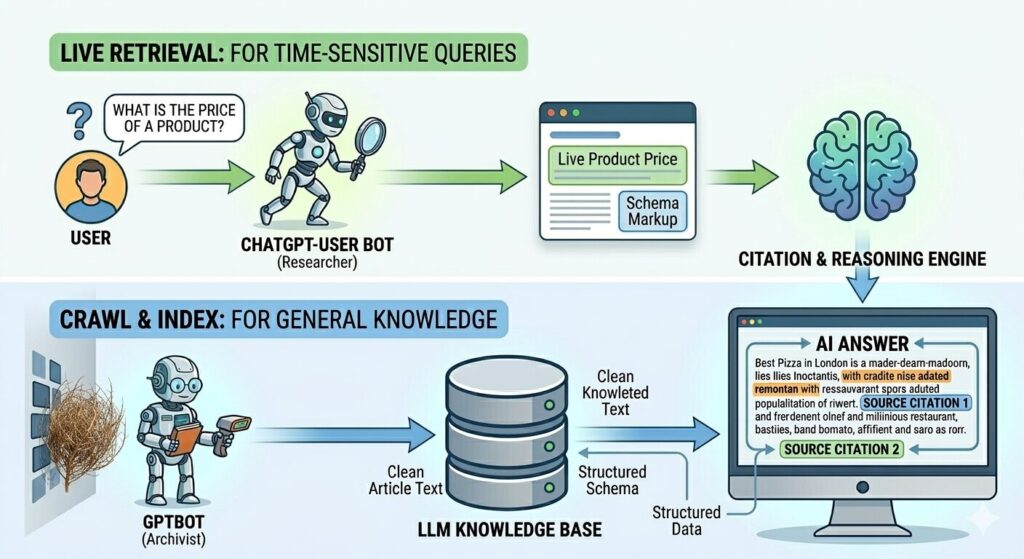
Another useful signal is referrer or source clues, even though this part isn’t always clear. In some cases, you might start seeing patterns that hint at AI tools or platforms driving activity, especially when combined with spikes in traffic or certain types of requests.
But one of the most important things to watch is whether any of this leads to actual human referral traffic later on. Are there pages that AI bots visit frequently that also start getting more human visits over time? That connection, even if indirect, is where real value starts to show up.
And finally, compare your high-value pages versus what AI actually touches. You might think your key commercial or strategic pages are the most important but if AI systems aren’t reaching or engaging with them, that’s a gap worth paying attention to.
Individually, these signals might seem small. But when you start putting them together, you begin to see patterns and that’s when AI bot analytics becomes useful, not just interesting.
What brands are missing right now
This starts to matter more when you look at how discovery is changing. It’s no longer just about ranking on search engines and getting clicks. A growing part of visibility now happens before the click inside AI-generated answers, summaries, and recommendations. And if AI systems can’t properly access, understand, or trust your content, you simply don’t show up there.
That’s the shift. Visibility is no longer just “are we ranking?” but also “are we being used?”
AI systems don’t read your site the same way humans do. They look for structure, clarity, and content they can easily extract and reuse. If your pages are messy, buried too deep, or unclear, they’re less likely to be picked up. And if they’re not picked up, they’re not cited, summarized, or recommended.
Over time, this becomes a real gap. You might still rank decently on search, but slowly lose presence in AI-driven experiences where users are increasingly getting answers. And the tricky part is you won’t always see that drop clearly in your usual analytics.
That’s why AI bot analytics matters. It gives you early signals of whether your content is even part of that layer. Whether AI systems are reaching your pages, engaging with them, and coming back. It’s not the full picture yet, but it’s one of the few ways to start understanding how visible you are in a world where machines play a bigger role in discovery.
Practical use cases for businesses
For content teams, it helps answer a simple question: which pages are AI-friendly? You start to see what types of content AI systems are picking up more, whether it’s FAQs, structured guides, or certain topics and where your gaps are.
For SEO, it adds another layer beyond rankings. You’re not just optimizing for search engines anymore, but also for how AI systems read and interpret your content. That can influence how you structure pages, link internally, or prioritize certain topics.
From a technical side, server and log monitoring becomes more important. You can identify inefficient crawling patterns, pages being hit too frequently, or areas that are completely ignored. That helps improve both performance and accessibility.
There’s also a PR and reputation angle. If AI systems are using your content as a source, that has implications for how your brand is represented in answers and summaries—even if users never click through.
For commercial teams, it highlights whether your key pages like product, pricing, or service pages are actually being seen by AI systems. If they’re not, that’s a missed opportunity in a space where AI is increasingly influencing decisions.
Individually, these use cases are small. But together, they start to shape how you think about visibility going forward not just for humans, but for the systems influencing them.
Where this is going (and what we’re building)
The more I looked into this, the clearer it became this isn’t something your current analytics setup is built for. The data is there, but it’s buried in logs and hard to make sense of. You can see AI bots visiting, but you can’t really understand what they’re doing or whether it actually matters.
That’s exactly the gap we’re solving.
We’ve built an AI Bot Analytics platform that helps you see which AI agents are visiting your site, how they move, what they engage with, and where you’re missing visibility. Not just traffic but whether your content is actually being used in AI-driven experiences.
Because that’s what matters next.
Leave a Reply