

Over the last decade, privacy shifted from being a compliance checkbox to a real operational dependency for marketing and analytics. The question is no longer “Are we compliant?” but “Can we still measure, retarget, personalize, and optimize performance under consent rules?” For us digital leaders, this shift affects audience sizing, attribution models, first-party data strategy, and even UX design. And it’s only accelerating.
Let’s break down the four major regulatory blocks shaping the future of data, consent, media and analytics.
The Big Four: What They Are and Where They Apply
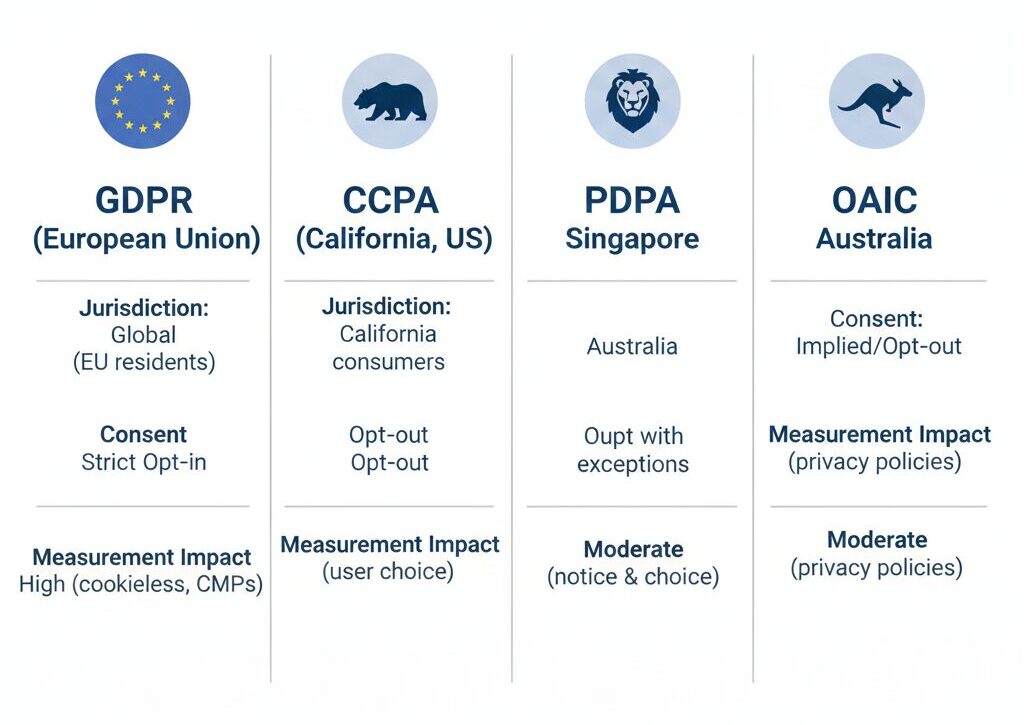
GDPR — European Union
GDPR (General Data Protection Regulation) remains the global reference standard. It applies to anyone who collects data from individuals in the EU — not just companies with offices there (source: GDPR Advisor). GDPR positions personal data as a user right, and violations have led to high-profile fines (CNIL’s €50M fine against Google and €35M against Amazon). Core ideas include explicit consent, user control, transparency and purpose limitation.
What are the key differences between GDPR and CCPA?
CCPA — United States (California)
CCPA (California Consumer Privacy Act) is currently the most influential US privacy law. It grants California residents the right to opt out of data collection and includes a private right of action for certain breaches. The US still has a patchwork approach, but enforcement is rising with the FTC cracking down on deceptive AI claims and data misuse. More states are adopting variants of CCPA and we expect federal alignment eventually.
PDPA — Southeast Asia (i.e., Singapore)
PDPA (Personal Data Protection Act, Singapore) takes a “balanced” approach designed to protect individuals while supporting economic activity (source: Wikipedia + CDP Institute). Singapore positions itself as a “trusted data hub”, and penalties can reach up to 10% of annual turnover for large organizations (CDP Institute). Malaysia and Indonesia are now moving in a similar direction as the region matures.
OAIC — Australia
Australia operates under the Office of the Australian Information Commissioner (OAIC). The country is moving fast toward stricter protections, including proposed bans on social media access for minors and age-appropriate design standards for platforms. This pushes brands to consider UX and consent flows for younger audiences much earlier in the design stage.
How These Laws Impact Your Marketing Regions
- Europe (EU): enforcement is strict and consistent. Consent must be explicit, not implied, and analytics/ad tags cannot fire pre-consent.
- United States (CA): fragmented but tightening. Growth teams need to prepare for state-by-state compliance.
- Singapore / SEA: governments want innovation + trust. CMPs and first-party data investments are now seen as competitive advantages.
- Australia / ANZ: child safety and data ethics are shaping UX and platform policies.
The Consent Banner: The Real Gatekeeper
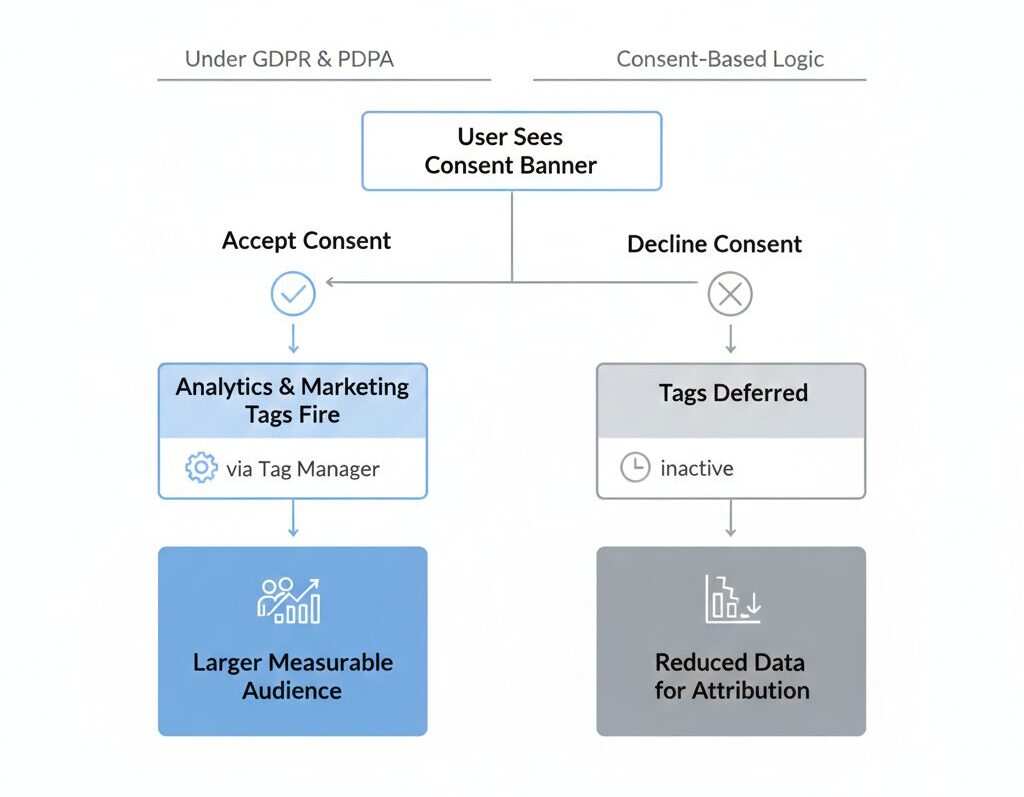
The “cookie banner” is the visual layer of a bigger consent process. Under GDPR and PDPA, consent must be obtained before marketing pixels and analytics tags activate. That means your tag manager, not just your designer, now plays a critical role.
If a user doesn’t accept cookies, GA4 and ad platforms cannot legally track. The most common compliance failure today isn’t legal misunderstanding, it’s operational misconfiguration in GTM, CMP, and trigger sequencing.
What Media, Analytics and Data Teams Must Know
This shift introduces three practical realities for operational teams:
1. Privacy by Design
Legal cannot be an afterthought. Consent and data classification must be designed into campaigns early, not patched on later.
2. Consent Fatigue Is Real
Research cited by Didomi showed most users would need 76 working days per year to read the privacy policies they encounter. In practice, users default to quick choices, leading to “consent fatigue” and lower opt-in rates unless UX is optimized.
3. First-Party Data Is Now the Safest Bet
With lawsuits rising around third-party tracking and cross-site identifiers, brands are shifting to CRM, login, and declared data strategies. This benefits media performance long-term because attribution becomes more direct and less probabilistic.
Stay Informed on Consent, Analytics & Performance
Why This Matters
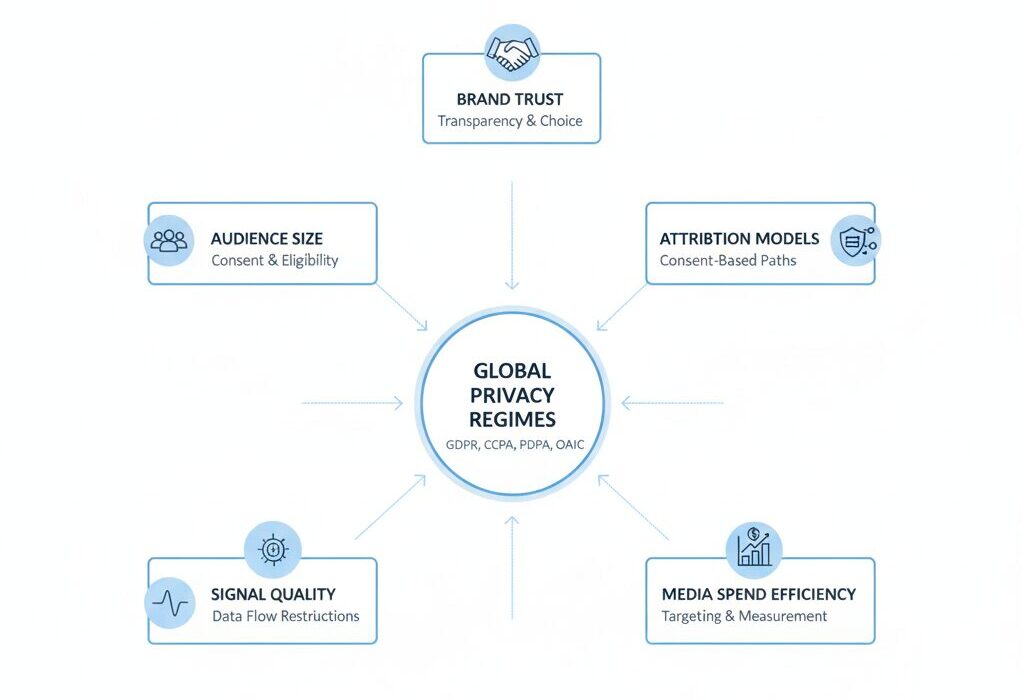
This is no longer just a compliance topic. It has measurable financial and strategic consequences:
- Audience Size: opt-in rates influence how many users you can remarket to
- Attribution Models: modeling fills gaps when tracking is blocked
- Signal Quality: platforms need consented signals to learn
- Media Spend Efficiency: decisioning breaks when data breaks
- Brand Trust: transparent data practices drive higher lifetime value
In short: without consent and clean first-party data flows, performance media loses its ability to optimize.
Privacy is now a structural component of marketing, not a legal footnote. The major privacy regimes (GDPR, CCPA, PDPA and OAIC) define how data can be captured, how consent must be obtained, and how measurement systems can operate. For marketing leaders, the implication is clear: consent and first-party data are now part of the growth stack. Teams that adopt CMPs, redesign consent UX, and align legal + analytics + media early will maintain performance and trust as privacy rules tighten.