

When people talk about cookies today, the focus is usually on tracking, ads, and personalization. But before any of that works, websites rely on a smaller, quieter category: essential cookies.
Essential cookies are the baseline. They keep a website functional, secure, and usable. Without them, even basic actions like logging in, submitting a form, or completing a checkout may fail.
What Are Essential Cookies?
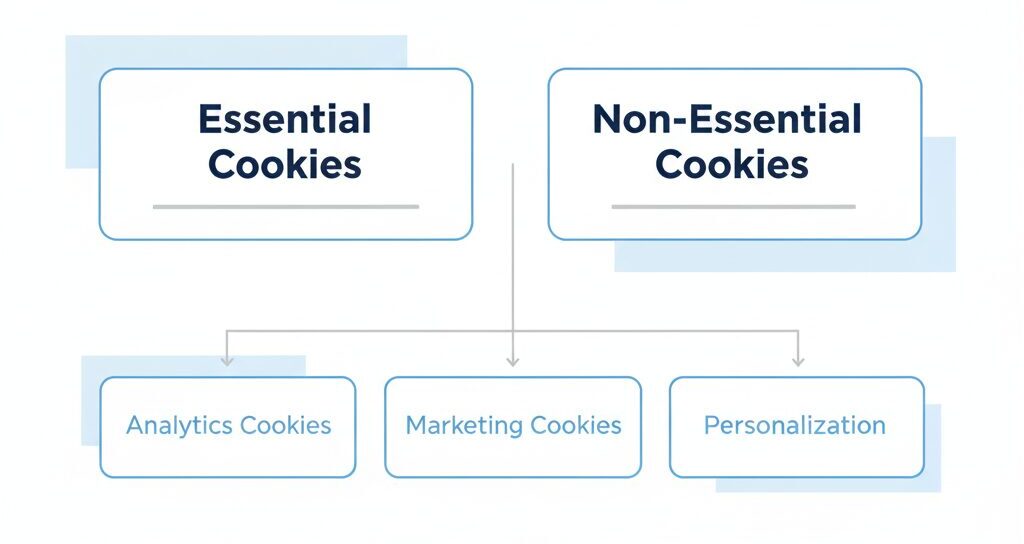
Essential cookies often referred to as strictly necessary cookies, are cookies required for a website to operate properly. They support core functions such as:
- Session management (keeping users logged in)
- Security and fraud prevention
- Load balancing
- Remembering user inputs during a session (e.g. shopping carts)
According to Wikipedia and EU regulatory guidance, these cookies are used either to carry out the transmission of a communication or to provide a service explicitly requested by the user. They are not designed for analytics, advertising, or profiling.
What Is the Purpose of Essential Cookies?
The purpose of essential cookies is functionality, not optimisation.
They ensure:
- The site works as expected
- Users can complete the actions they intend to
- The platform remains stable and secure
From a business perspective, essential cookies protect the user experience. They don’t generate insights or improve targeting, but they prevent immediate friction and failure.
Do Essential Cookies Have an Impact?
Yes!, but not in the way marketing or analytics cookies do.
Essential cookies impact:
- Site reliability
- Security
- User trust
They don’t improve attribution or audience sizing, but without them, there is no meaningful data to measure in the first place. They are the foundation on which all other consented data activity depends.
Do You Need Consent for Essential Cookies?
In most cases, explicit consent is not required for essential cookies.
Under GDPR, strictly necessary cookies are exempt from consent requirements as long as they are genuinely required to deliver a service requested by the user. Similar principles apply under PDPA-style frameworks, where necessity, proportionality, and transparency are key.
However, disclosure is still required. Users should be informed about what essential cookies do and why they exist, typically through a cookie or privacy policy.
PDPA vs GDPR: How Essential Cookies Are Applied
| Area | GDPR-Focused Markets (EU/UK) | PDPA-Focused Markets (e.g. Singapore) |
|---|---|---|
| Interpretation of “Essential” | Narrow and strict | More pragmatic and purpose-based |
| Consent for essential cookies | Not required if strictly necessary | Not required if reasonable and necessary |
| Enforcement focus | Banner behaviour and consent mechanics | Transparency, accountability, reasonableness |
| Risk area | Misclassifying analytics as essential | Poor documentation or unclear purpose |
Best practice: implement essential cookies to GDPR standards globally, then localise language and UX for PDPA markets.
How This Connects to Script Gating
This is where script gating becomes critical.
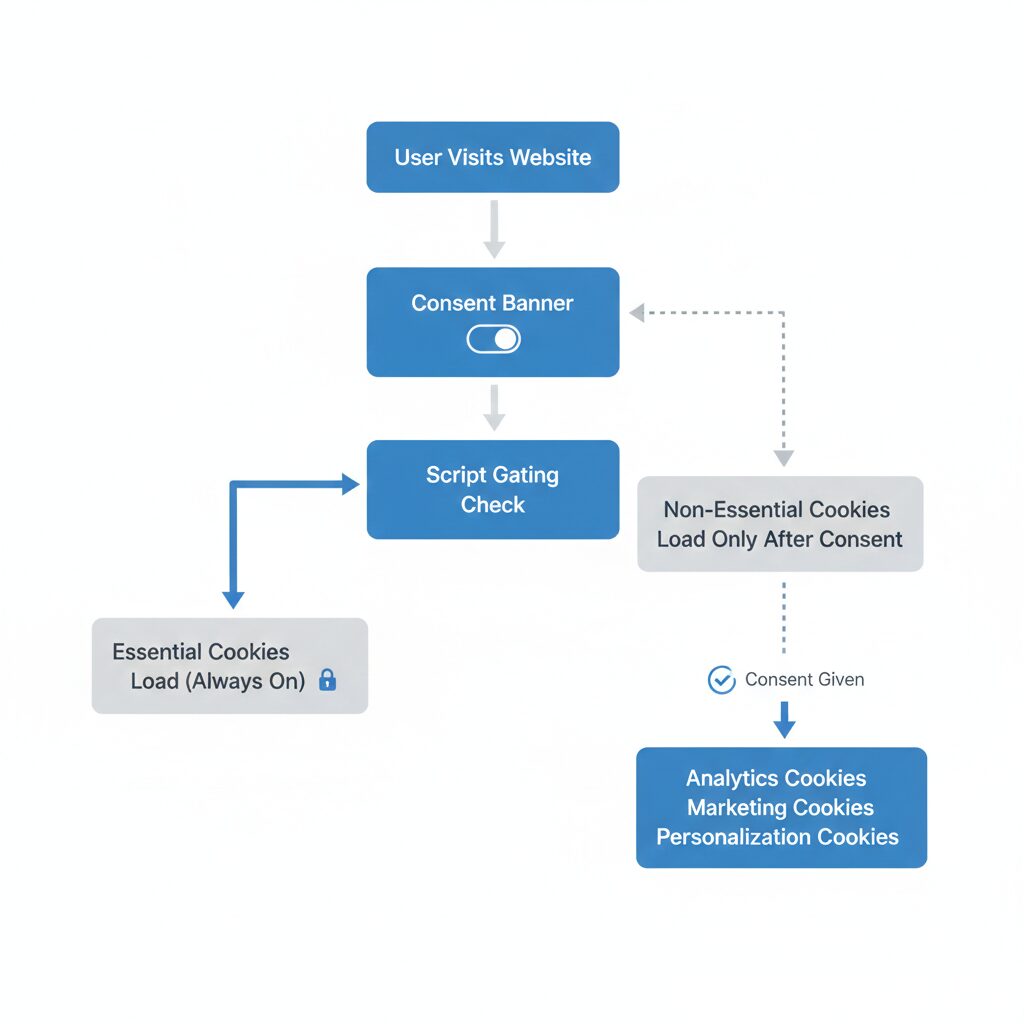
Script gating ensures that:
- Essential cookies and scripts load by default
- Analytics, marketing, and personalization scripts only load after consent
In practice:
- Essential scripts are allowed to run immediately to keep the site functional
- Analytics scripts wait for analytics consent
- Marketing scripts wait for marketing consent
- Personalization scripts wait for personalization consent
This technical separation prevents essential cookies from being misused as a loophole for tracking and ensures compliance across both GDPR and PDPA markets.
How Essential Cookies Compare to Other Cookie Categories
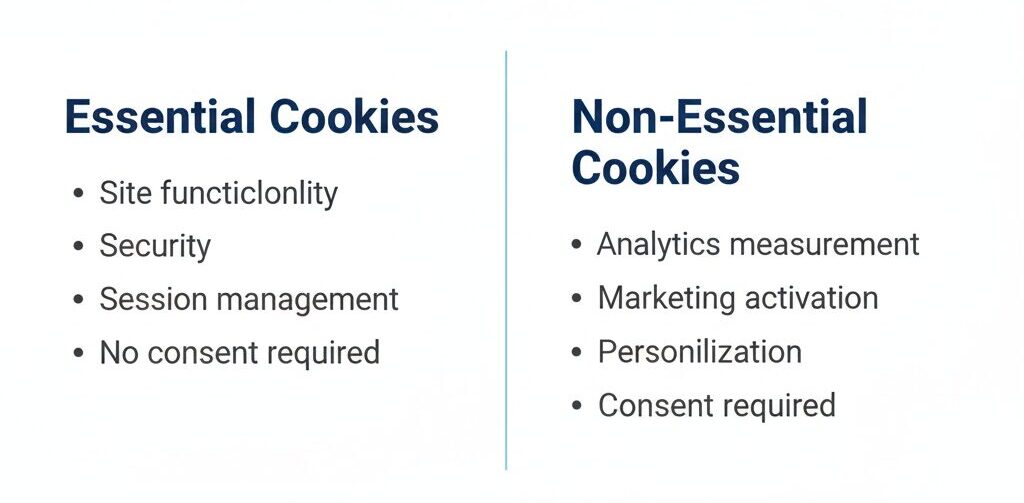
-
Essential cookies
Always on. Required for site functionality. No consent required, but disclosure is mandatory. -
Analytics cookies
Used to measure behaviour and performance. Consent required. -
Marketing cookies
Used for advertising and retargeting. Explicit consent required. -
Personalization cookies
Used to tailor experiences beyond basic functionality. Consent required.
Treating these categories differently both in policy and in code is what makes a consent strategy credible.
The Bottom Line
Essential cookies are not about tracking users. They are about keeping the site usable and secure.
You don’t need consent to use them, but you do need discipline: clear definitions, proper documentation, and technical controls like script gating. Once you move beyond essential cookies, consent is no longer optional, it becomes a hard boundary.
That distinction is what separates compliant setups from fragile ones.