

Every marketer today talks about hyper-personalization. We want to tailor journeys, recommend products, optimize creatives and trigger the right channel at the right moment. But before any of that can happen, there’s a more basic question few teams ask: are you even allowed to activate the scripts that make personalization possible?
That’s where script gating comes in. Script gating means tracking, personalization and advertising scripts only activate after the user grants consent. Without it, analytics breaks, media cannot optimize, and personalization becomes non-compliant.
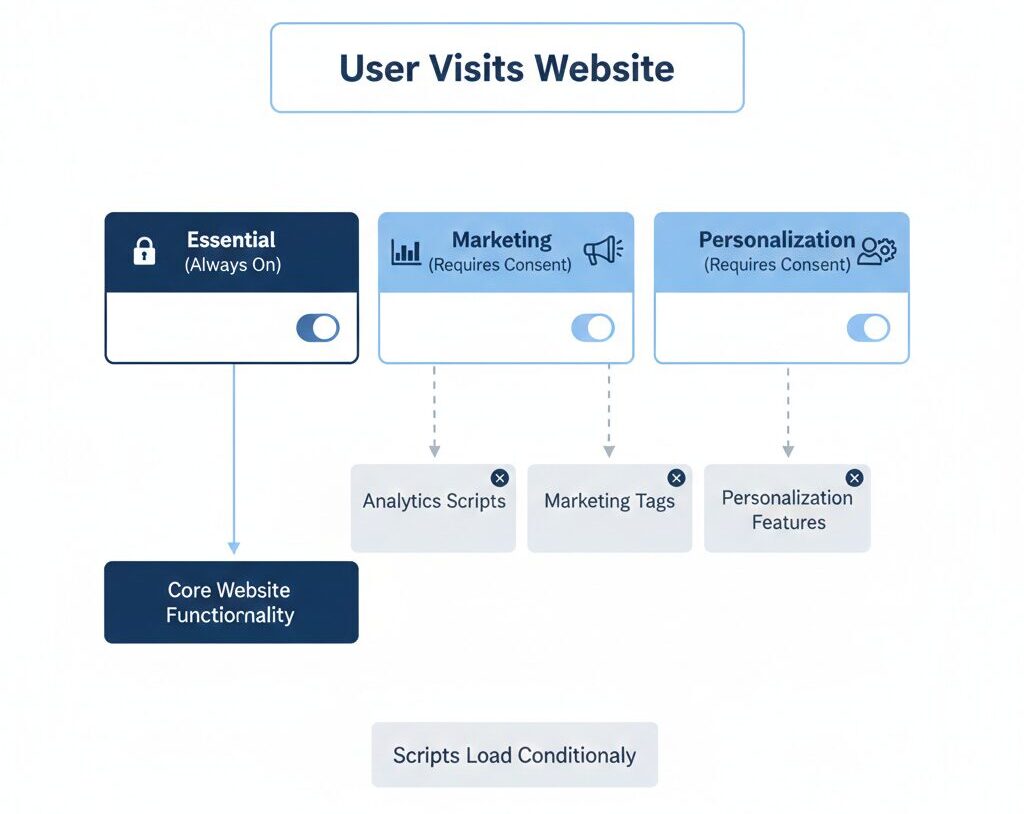
Consent Categories Explained (Plain English)
Most modern Consent Management Platforms (CMPs) classify scripts into categories that match legal requirements:
| Category | Description | Consent Requirement |
| Essential | Needed for basic site functionality | Always On |
| Analytics | Measures behavior and journeys | Requires Consent |
| Marketing | Ad targeting & conversion tracking | Requires Consent |
| Personalization | Recommenders, A/B testing, UX adjustments | Requires Consent |
Why you need a Consent Management Platform?
This category model prevents sites from firing everything by default and instead creates a clean mapping between user choice → vendor activation.
| Vendor / Script | Category |
| GA4, Adobe Analytics | Analytics |
| Meta Pixel, TikTok Pixel, Google Floodlight | Marketing |
| Adobe Target, Dynamic Yield, Optimizely, Hotjar Heatmaps | Personalization |
| Payment, Cart, Login, Session, Security Cookies | Essential |
These examples aren’t theoretical. CMPs such as OneTrust, Didomi, and Usercentrics use nearly identical classifications in production environments.
Stay Informed on Consent, Analytics & Performance
Script Gating in Practice (Real Use Cases)
Several brands have adopted strict consent gating as personalization strategies matured:
- Sephora uses CDPs to activate cross-channel personalization only after logged-in or consented user status is known (source: Twilio Segment, 2023 State of Personalization Report).
- The New York Times gated advertising personalization behind first-party registration and consent to reduce reliance on third-party cookies (source: NYT Advertising & Digiday).
- Zalando implemented preference-based consent to control marketing activations as part of its GDPR compliance (source: Zalando Annual Report, 2022).
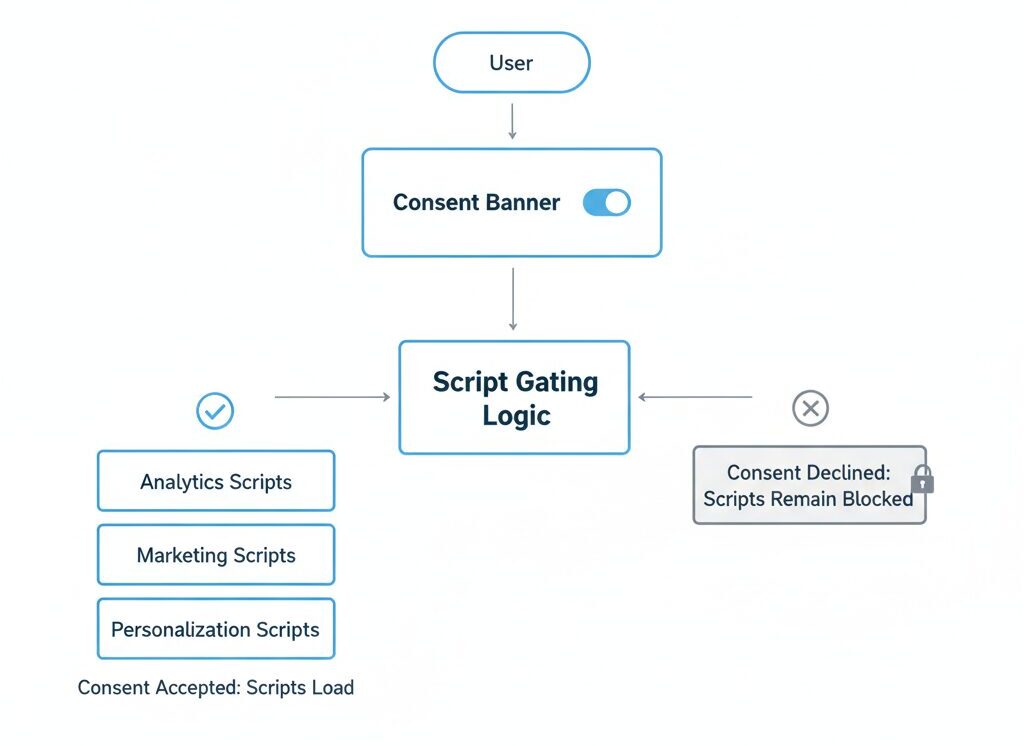
These examples show personalization doesn’t scale without trust and consent infrastructure.
The Data Activation Flow: Old vs. Modern
For years, marketing stacks followed a linear “tracking first, ask later” approach:
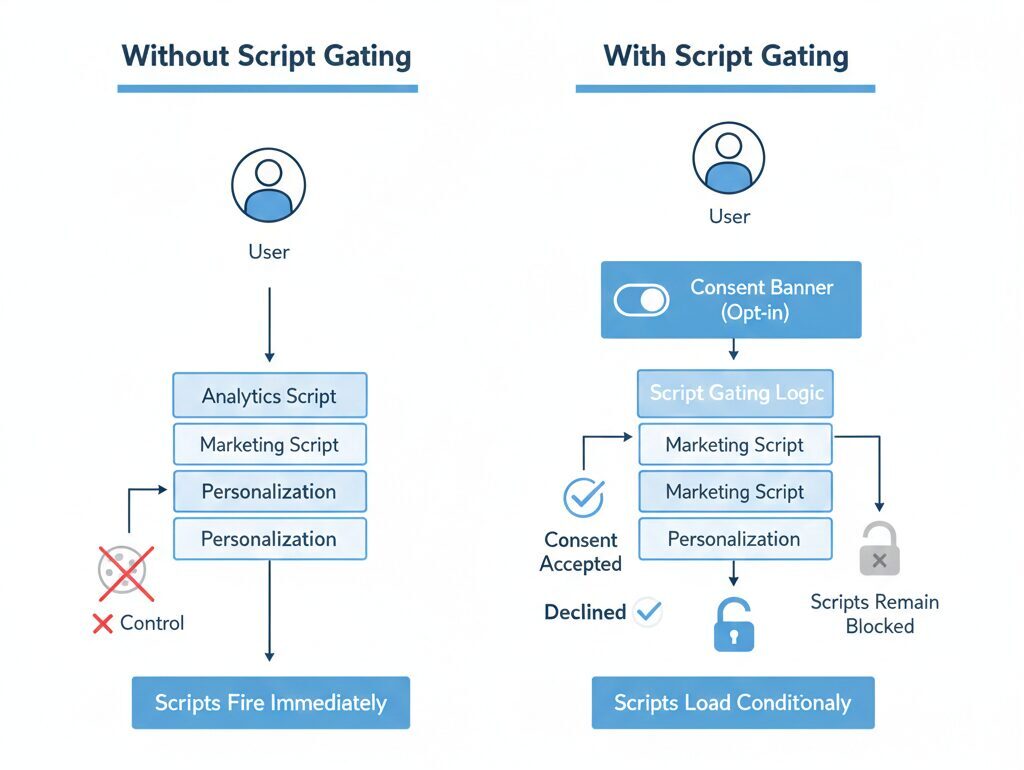
OLD MODEL
CMP → CDP → DMP → DSP → Ad Delivery
This assumed third-party cookies, shared IDs, and broad remarketing pools.
The modern stack looks different:
NEW MODEL
CMP → CDP → Clean Room → DSP
Here’s why the shift happened:
- CMP manages consent and legal basis
- CDP ties first-party data to user identity
- Clean Rooms (e.g., Google Ads Data Hub, Amazon Marketing Cloud, Meta ACR) enable privacy-safe audience matching
- DSPs activate media without exposing raw user data
- This architecture allows personalization without leaking identifiers.
Why should we care?
Script gating isn’t just a legal checkbox:
✔ It protects attribution and signal quality
✔ It enables modeled conversions in ad platforms
✔ It unlocks compliant personalization and experimentation
✔ It future-proofs against cookie deprecation
Without it, marketing performance degrades and personalization stalls.