
For most DSP teams today, the real problem isn’t media choice. It’s signal quality.
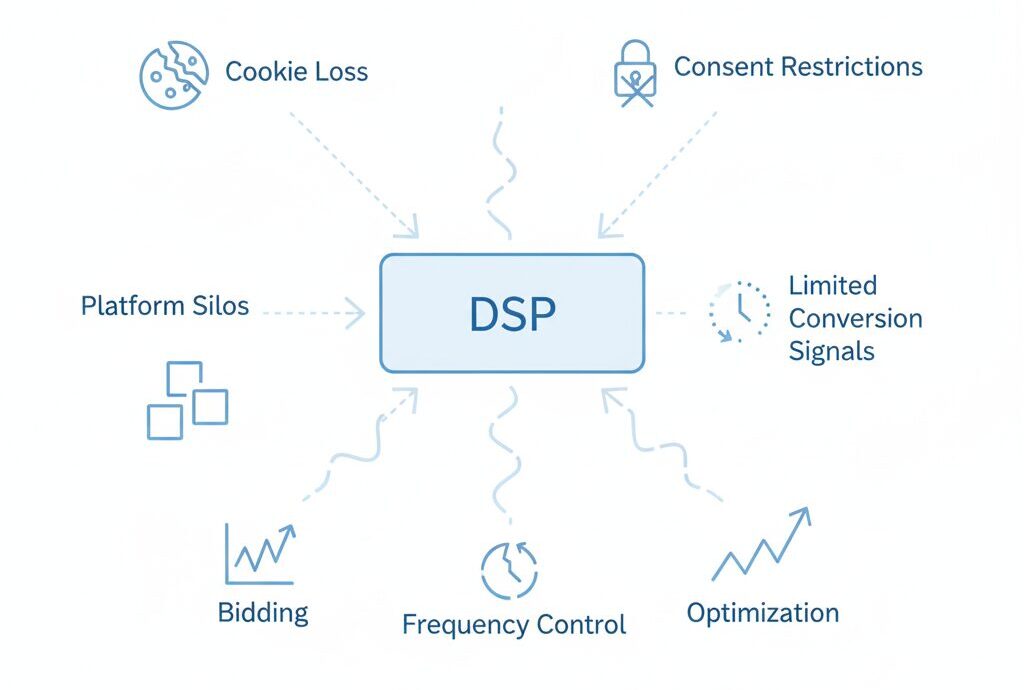
As identifiers disappear, consent rules tighten, and data gets split across platforms, the signals that DSPs rely on are getting weaker. Conversion data is patchy. Audience understanding is less clear. Frequency control becomes guesswork. And proving incrementality gets harder every quarter.
When those signals degrade, DSP bidding models lose confidence. Optimisation slows down. And performance teams end up making big budget decisions with less certainty than they used to.
This is where data clean rooms stop being a “nice-to-have” and start becoming core infrastructure. They give teams a way to work with sensitive data, learn what’s actually happening, and improve decision-making without exposing raw, user-level data. In a privacy-first world, that trade-off matters.
What “signal enhancement” really means for DSP performance
Signal enhancement today is not about replacing cookies with another identifier. That mindset is already outdated.
In practice, signal enhancement means improving the quality and usefulness of the inputs that DSPs can still act on:
- Clearer audience definition, knowing which groups matter and why
- Stronger links between exposure and outcomes
- More reliable conversion feedback, even when identifiers are limited
- Better reach and frequency decisions across channels
- More stable inputs for bidding and optimisation models
The objective is simple help DSPs make better decisions using signals that are privacy-safe, durable, and aligned with how platforms now operate.
What a data clean room actually does (in media terms)
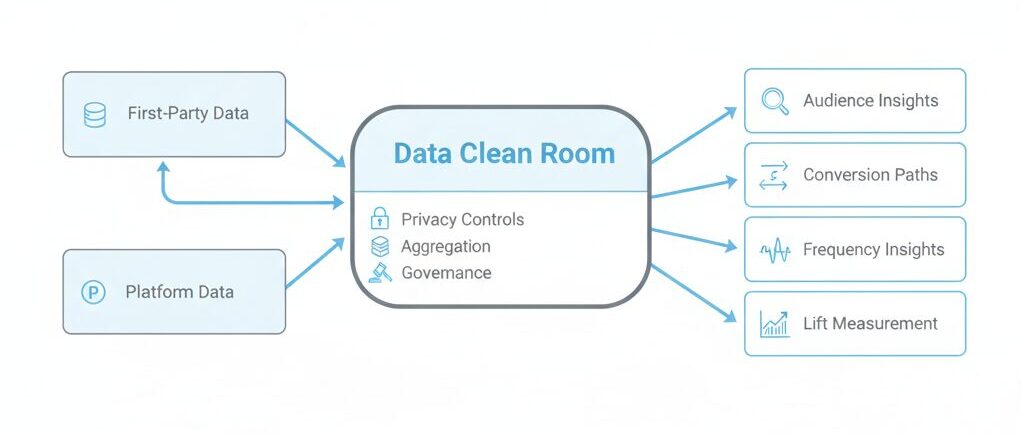
At its core, a data clean room is a controlled environment where two or more parties can analyse combined datasets without sharing the underlying raw data.
Instead of moving files around or exposing user-level records, each side keeps control of its data. Queries run under strict rules. Outputs are aggregated, privacy-checked, and governed.
From a media perspective, this means you can answer questions like:
- Did exposure drive outcomes?
- Which cohorts behave differently?
- Where is overlap or waste happening?
All without downloading personal data or breaking consent rules.
That’s the key point: clean rooms don’t give you more personal data. They give you better intelligence about what’s working and how to adjust under governance.
To learn more about data clean rooms, please watch the video below by AWS.
Where clean rooms show up in the ecosystem
Stay Informed on Consent, Analytics & Performance
Clean rooms generally fall into three patterns:
1) Platform or walled-garden clean rooms
These live inside large platforms and focus on measurement and audience insight.
Examples include environments that let you combine your first-party data with platform event data and return only aggregated results. The outputs are designed for analysis, not user-level targeting.
Google Ads Data Hub
A privacy-safe environment that lets advertisers analyse Google Ads exposure and outcomes using aggregated data without accessing user-level information.
Amazon Marketing Cloud
A cloud-based clean room where advertisers can combine their data with Amazon Ads signals to understand shopping behaviour, reach, and conversion paths in a privacy-safe way.
Meta Advanced Analytics
Meta’s privacy-controlled analytics environment designed to support conversion lift, attribution, and performance analysis as user-level tracking becomes more limited.
TikTok PrivacyGo Data Clean Room
An open-source clean room framework from TikTok that demonstrates how privacy-enhancing technologies can support outcome measurement without exposing raw data.
LinkedIn Ads Analytics
An aggregated, privacy-safe analytics setup within LinkedIn Ads that helps B2B advertisers measure reach, engagement, and campaign impact at an account or cohort level.
2) Cloud-based clean room infrastructure
Cloud providers offer neutral building blocks that allow partners to collaborate without copying or exposing underlying datasets.
These setups are often used when brands, agencies, and partners want more flexibility while still enforcing strict access controls and privacy rules.
Google BigQuery Data Clean Rooms
A neutral clean room setup that allows brands and partners to analyse combined datasets inside BigQuery while keeping raw data separate and outputs aggregated.
AWS Clean Rooms
A managed service from AWS that lets multiple parties collaborate on sensitive datasets using defined rules, without sharing or copying underlying data.
Snowflake Data Clean Rooms
A clean room capability built into Snowflake that enables secure data collaboration across organisations while enforcing privacy controls and governance.
Databricks Clean Rooms
A privacy-safe collaboration pattern on Databricks that supports advanced analytics and modelling on shared datasets without exposing user-level data.
InfoSum
A decentralised clean room platform that allows data matching and analysis across parties without moving or exposing raw data at all.
3) TikTok-related clean room and privacy-enhancing approaches
TikTok has publicly discussed clean-room-style collaboration using privacy-enhancing technologies, including trusted execution environments.
They’ve also released open-source frameworks that show how privacy-safe collaboration and measurement can work, especially for understanding outcomes like conversion lift — without exposing user data.
The important nuance: this reflects TikTok’s documented direction around privacy-safe measurement, not a claim about proprietary advertiser tools beyond what’s publicly stated.
How clean rooms enhance DSP signals in practice
When teams use clean rooms well, four use cases consistently show up:
1) Audience enrichment
You can validate overlap between your first-party segments and platform or partner cohorts. The output isn’t raw identities, it’s better segment definitions, scoring logic, or eligibility rules.
2) Conversion signal recovery
Instead of relying only on fragile last-click signals, clean room analysis helps connect exposure to outcomes at an aggregated level. Those insights can be used to tune bidding strategies and event priorities.
3) Cross-channel frequency and duplication insight
Clean rooms are very effective at showing where the same audiences are being over-served across platforms, and where incremental reach actually comes from. This supports smarter frequency caps and budget shifts.
4) Model and strategy tuning
Even without user-level feeds, aggregated insights still improve optimisation. Teams can learn which events are predictive, where diminishing returns start, and which cohorts convert more efficiently.
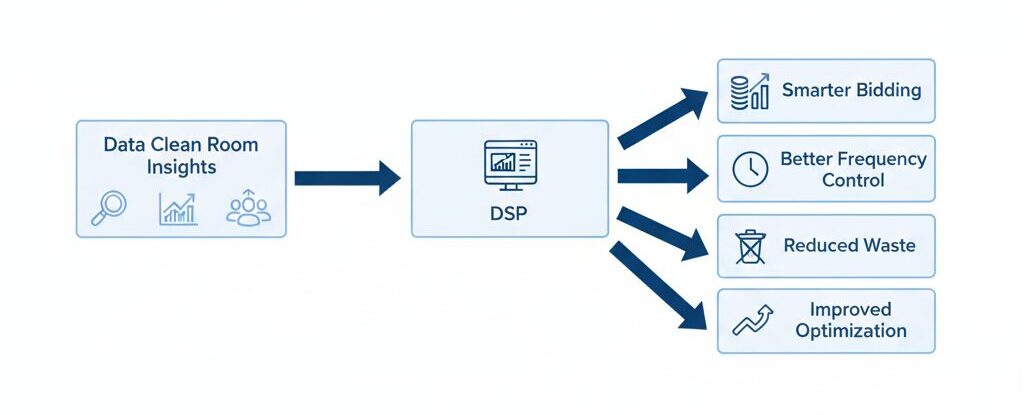
How insights flow back into the DSP
The clean room outputs that matter are the ones you can act on:
Cohorts : Activation audiences (where allowed)
Suppression groups : Exclusions to reduce waste
Lift and path insights : Bidding logic and KPI weighting
Frequency findings: Reach planning and guardrails
Teams that get value from clean rooms treat them as part of the media operating system not a one-off analytics exercise.
Summary
In a privacy-first world, the advantage isn’t having more data. It’s designing better signals with governance built in.
Data clean rooms help DSP teams regain confidence in optimisation by using collaboration patterns that platforms and regulators can support. For media leaders, that’s the real win: sustainable performance, without betting the strategy on identifiers that keep disappearing.